Explainability & HITL
AnamDB ensures trust and reliability in AI-driven data pipelines using a three-tier system: Explainability, Human-in-the-Loop (HITL) semantic monitoring, and Syntactic Self-Repair.
The Query Explainer
Every query in AnamDB can generate a reasoning trace. You can extract explanations at two levels of detail.
1. Coarse-Grained Summary
A high-level summary of the rules applied, the models loaded, execution device statistics, and output probability distributions.
═══════════════════════════════════════════════════════════
  AnamDB Query Explanation
  Level: Coarse
═══════════════════════════════════════════════════════════

─── Pipeline Summary ───────────────────────────────────
  Produced 1,247 row(s) across 1 batch(es)
  Provenance Mode: Polynomial
  Schema: [amount:Float64, fraud_prob:Float64, merchant_type:Utf8]

  Score Distribution (fraud_prob):
     min=0.7012, max=0.9987, mean=0.8834, median=0.8921

─── Rules Applied ──────────────────────────────────────
  • high_risk       ← fraud_prob > 0.90 AND amount > 10000
  • velocity_check  ← amount > 5000 AND fraud_prob > 0.70

─── Models Used ────────────────────────────────────────
  • fraud_detector v1.0.0 (ONNX, avg_latency: 5.0ms)

─── Device Pool ────────────────────────────────────────
  • CPU: 8 cores active
  • Apple Metal: 1 device active (M2 GPU)
═══════════════════════════════════════════════════════════
2. Fine-Grained Lineage
A detailed, mathematical trace of every row in the result set back to its input row IDs and model version identifiers.
─── Per-Row Lineage ────────────────────────────────────
  Row 0: Derived via fraud_detector using model 'v1.0.0',
         sourced from [txn_38291, txn_38292]
  Row 1: Derived via fraud_detector using model 'v1.0.0',
         sourced from [txn_44107]
Semantic Anomaly Monitor
Traditional databases silently return empty tables or biased predictions if a neural model degrades. AnamDB runs an in-line Semantic Monitor that scans output Arrow batches for statistical anomalies:
| Anomaly Pattern | Cause | Severity | Warning |
|---|---|---|---|
| Low-Confidence Rate | Model outputs fall below threshold | Warning | 100% of rows have fraud_prob below 0.5 |
| Uniform Score Distribution | Model output is flat/stuck | Warning / Critical | All rows have identical predictions |
| Skewed / Empty Outputs | Logic filter is overly restrictive | Info / Warning | 99% of input rows filtered out |
Interactive Triage
When the Semantic Monitor detects an anomaly, the database session pauses query execution and enters Triage Mode. Developers or administrators can resolve anomalies through a interactive loop:
═══ Semantic Anomaly Triage ═══

[Anomaly 1]
  Severity: WARNING
  100% of rows have fraud_prob below 0.5 (threshold: 80% max).
  Affected rows: 9,216
  Suggested: Consider using a higher-accuracy model.
  Action: RetryWithModel("fraud_detector")
The session prompts for one of four actions:
Accept: Acknowledge the anomaly and continue execution.Correct("..."): Provide natural-language feedback (e.g., "Filter out APAC region transactions"). AnamDB translates this to a Datalog rule patch on-the-fly and runs the query again.RetryWithModel("..."): Dynamically swap the model operator for a different version on the Pareto frontier and re-run.Abort: Cancel execution immediately.
Syntactic Self-Repair Loop
In addition to semantic checks, AnamDB runs a background self-repair agent to handle system and runtime exceptions automatically:
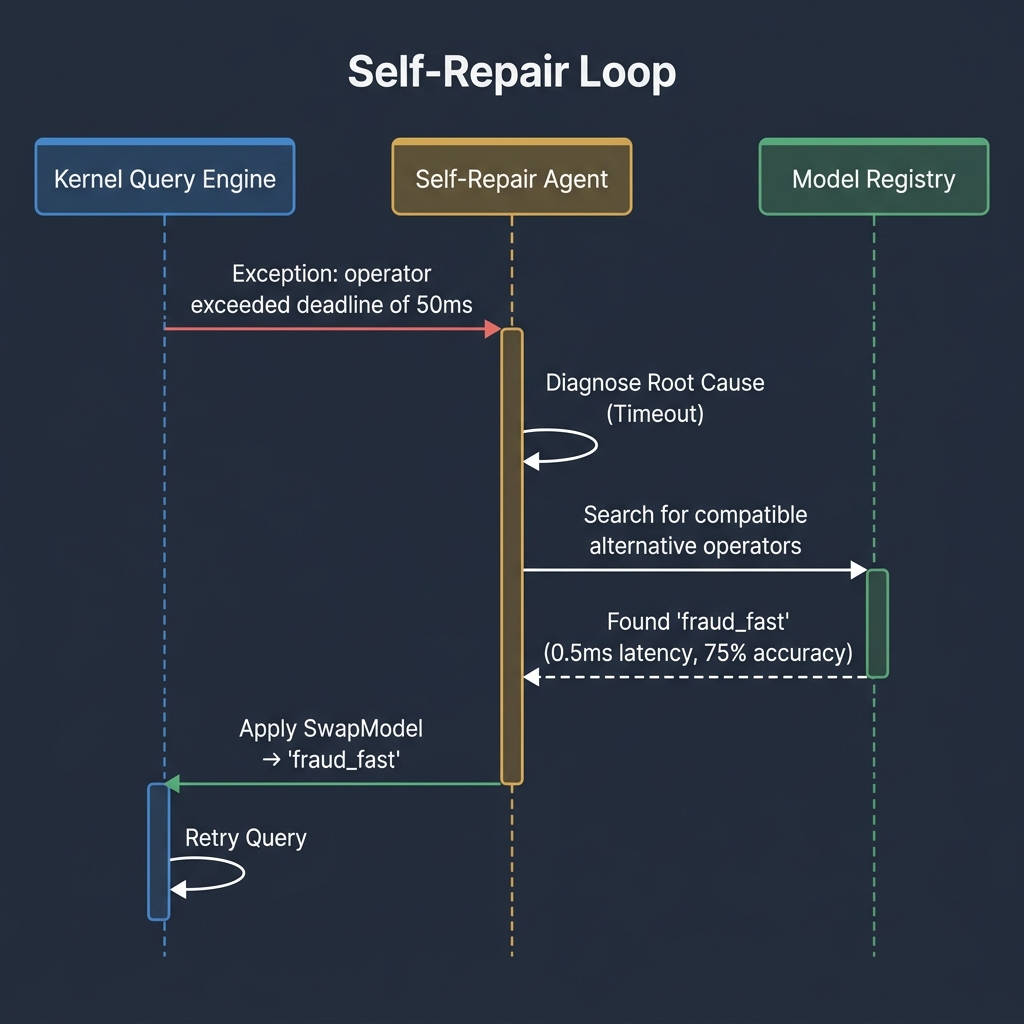
Self-Repair Matrix
- Recoverable Shape Mismatch: Swap to compatible input shape model.
- Recoverable Timeout / Deadline: Swap to faster variant on the Pareto frontier.
- Recoverable Missing Values: Retry with adjusted null-imputation parameters.
- Degraded Out-of-Memory (OOM): Swap to a quantized variant, or disable GPU dispatch and process on CPU.
- Fatal Core Failures: Escalate to the host application / developer.